sales growth meeting 11th
Table of Contents
- Slide 1: Opening (2 min)
- Slide 2: Why This Matters (3 min)
- Slide 3: Charlie Munger’s Core Way (4 min)
- Slide 4: The Lollapalooza Effect (5 min)
- Slide 5: Sales Examples of Lollapalooza (4 min)
- Slide 6: Charlie Munger on Learning (3 min)
- Slide 7: Anurag Ravat Story (4 min)
- Slide 8: Practical Sales Takeaways (2 min)
- Slide 9: Team Commitment (2 min)
- Slide 10: Close (1 min)
Slide 1: Opening (2 min)
Charlie Munger's Lollapalooza Effect, and Sales Discipline
- think better, act better, and avoid stupid mistakes.


"When several models combine, you get lollapalooza effects; this is when two, three, or four forces all operating in the same direction. And frequently, you don’t get simple addition. It’s often like a critical mass in physics where you get a nuclear explosion if you get to a certain point of mass …"
- Charlie Munger
Slide 2: Why This Matters (3 min)
Sales is not only effort, it is judgment
- In sales, many mistakes happen not because people are lazy, but because they think badly.
- A small bias can become a big failure when many forces act together.
- Munger’s idea is useful here:
- use multiple models,
- keep it simple,
- and watch how forces combine.
Slide 3: Charlie Munger’s Core Way (4 min)
Think in a disciplined way
- Keep things simple.
- Be patient.
- Learn continuously.
- Use checklists.
- Know what you do not know.
- Invert problems:
- ask what can go wrong,
- then avoid it.
- Do not confuse activity with progress.
- Do not confuse smartness with results.
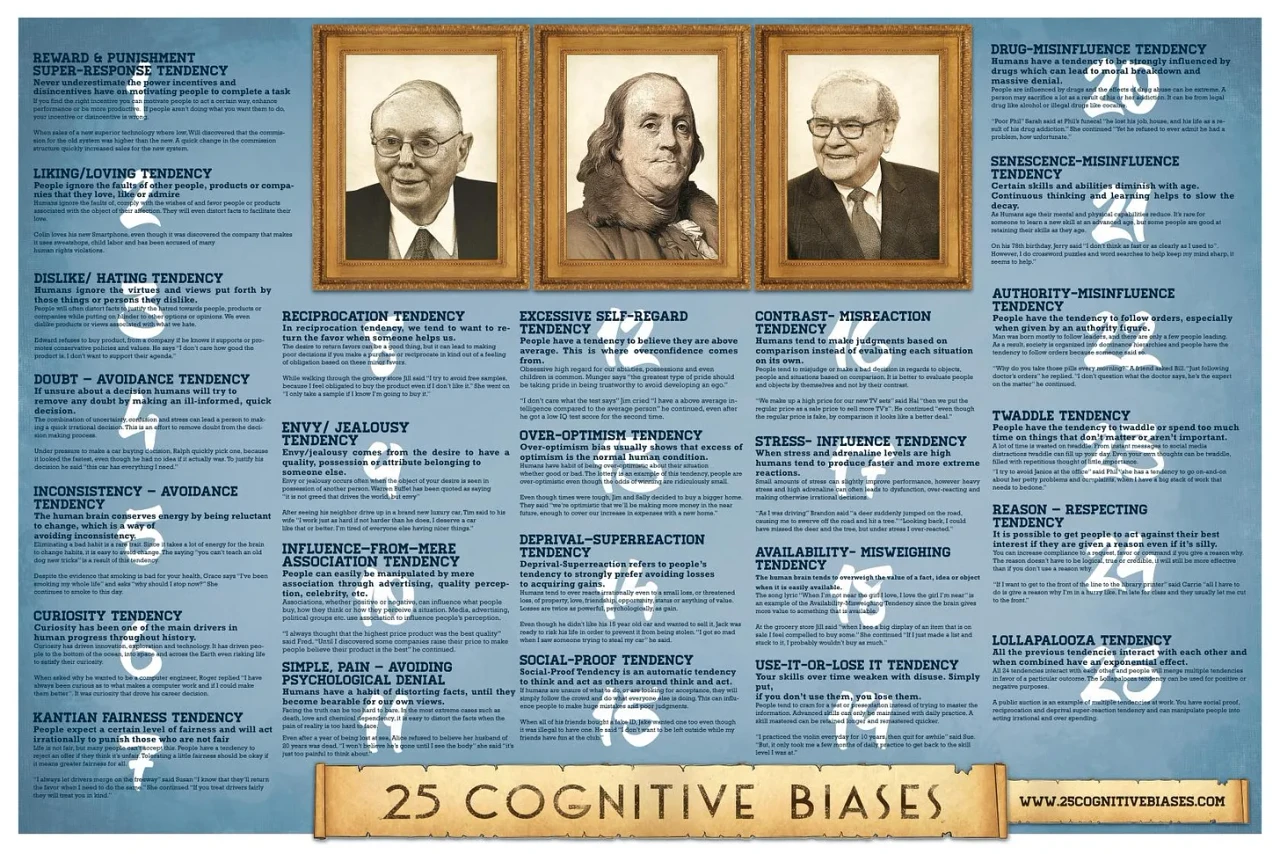
Slide 4: The Lollapalooza Effect (5 min)
When many forces act together, the result becomes huge
- Lollapalooza means multiple psychological forces pushing in the same direction.
- One force alone may not be enough.
- But several together can create a powerful effect.
In sales, this can happen when:
- social proof,
- scarcity,
- urgency,
- commitment,
- and authority
all work together.
- The same idea also works in a bad way:
- fear + ego + hurry + poor incentives can create a bad decision.
- Lesson:
- do not judge one factor alone,
- look at the combined effect.
Slide 5: Sales Examples of Lollapalooza (4 min) 1
How it appears in our daily work
- Customer sees a machine on WhatsApp.
- Another buyer has already shown interest.
- Seller says “last piece available.”
- The deal feels urgent.
- The customer wants to avoid missing out.
- Now several forces are acting together:
- availability,
- fear of missing out,
- social proof,
- and commitment.
- That is how a deal can move fast.
- We should also use this ethically:
- clear facts,
- clear value,
- clear next step.
Slide 6: Charlie Munger on Learning (3 min)
A few memorable points
- “You don’t have to be brilliant, only a little bit wiser than the other guys, on average, for a long, long time.”
- “There is no way you can live an adequate life without making mistakes.”
- “A majority of life’s errors are caused by forgetting what one is really trying to do.”
- Sales lesson:
- stay simple,
- wait for the right chance,
- and keep learning.
Slide 7: Anurag Ravat Story (4 min)2
Resilience and self-belief
- Use the Anurag Ravat story as an example of resilience.
- The point is not that life is easy.
- The point is that people can rise when they:
- keep moving,
- keep learning,
- and refuse to stay defined by difficulty.
- This fits sales perfectly:
- rejection is not identity,
- setback is not finality,
- today’s loss is not tomorrow’s limit.
- Message:
- strength is built through response, not comfort.
Slide 8: Practical Sales Takeaways (2 min)
Slide 9: Team Commitment (2 min)
One action for each person
- Identify one deal where:
- you acted too fast,
- or hesitated too long,
- or got carried away by pressure.
- Write:
- what you saw,
- what you missed,
- and what you will do differently next time.
Slide 10: Close (1 min)
Final line
- In sales, our goal is not only to work hard.
- Our goal is to think clearly, act simply, and avoid errors that multiply.
- That is how we build long-term success.